
Top 7 Generative AI Courses to Do in 2026
 Shivam Singh1 Jun, 2026

Do you want to be well-versed with Generative AI and keep up with the whirlwind technology? It doesn't matter if you are a student or a working professional; taking a Generative AI course is almost always reliable in paving its way to many exciting career prospects. This blog will talk about the 7 best Generative AI courses you should consider taking in 2026, some reasons why you should consider them.
Why Choose Generative AI Courses?
Generative AI is already rampaging through industries, and health is one of them, entertainment, and marketing. Through a proper course on Generative AI, one can prepare himself to understand how such models are developed in AI that can produce text, images, sounds, etc. Industries are very much interested in employing human resources that are skilled in Generative AI. It's a good field to be in to make money. By 2026, demand will be exceedingly high for Generative AI experts, so now go on and get a head start.
7 Best Generative AI Courses in 2026
1. DeepLearning.AI's Generative AI with Large Language Models
This Generative AI course from Andrew Ng's DeepLearning.AI covers LLMs, transformers, and hands-on applications. The perfect fit for those interested in hands-on AI modeling.
2. Generative AI for Everyone on Coursera by Andrew Ng
Hands-on introduction to Generative AI from first principles, very low on programming. This course is for individuals who want a basic sense of how Generative AI will impact businesses, but don't want to delve too deeply into theory.
3. Nanodegree in Generative AI from Udacity
This practical AI course involves working with GANs, VAEs, and diffusion models. This course is designed for students who prefer real-world initiatives along with mentorship.
4. Professional Certificate in Machine Learning and AI by MIT
This comprehensive course that covers aspects of Generative AI is best suited for someone who wishes to learn advanced concepts like neural networks and deep learning for generative models.
5. Generative AI Learning Path by Google Cloud
Google designed the Generative AI training pathway to include tools such as Vertex AI and PaLM 2. This pathway mostly caters to professionals who want to master deploying AI solutions on the cloud.
6. CS330: Deep Multi-Task and Meta Learning by Stanford
Heavy generative AI for advanced movers going deeply at multi-task learning, how to optimize generative models.
7. LinkedIn Learning's Generative AI for Creative Professionals
A specialized Generative AI course for designers and content authors on using AI tools like DALL-E and Midjourney.
How to Select the Best Generative AI Course for You
Generative AI courses differ in content and approach as some courses emphasize coding and model-building, while others emphasize business applications and strategy. The process can get quite confusing, so how can you pick the right course for your needs? Here is a handy little guide to help you with the process.
1. Assess Your Present Skills
What level of general AI expertise do you have? Some Generative AI courses start all the way down to the basics of machine learning, while some assume prior knowledge of Python and neural networks. It would thus be wise to pick the course that matches your skill level lest you find the whole thing boring or frustrating.
2. Clarify Your Career Vision
Is your next step to become an AI researcher or prompt engineer or an AI-friendly business leader? Technical jobs need hands-on coding projects, while marketing, design, and management need Generative AI courses that teach real-world application rather than the theory of the algorithms.
3. Course Content
Generative AI courses probably include important topics such as:
Large Language Models (LLMs) (such as GPT-4, Claude)
Diffusion models (such as Stable Diffusion, DALL-E)
Generative Adversarial Networks (GANs)
4. Style of Learning and Format Considered
Would you prefer to learn at your own pace or in a live setting with mentor insight? Programs like Coursera and Udemy offer this kind of flexibility, while boot camps (for example, Udacity, Springboard) provide structure through hard deadlines and instructor mentorship. If your best form of learning is by doing, then select a Generative AI course with a focus on projects and case studies.
5. Search for an Industry-Recognized Certification
Some employers value certain certifications from Google, DeepLearning.AI, or Stanford more than others. If career advancement is what you want to achieve, then choose a course on Generative AI that comes with a well-respected credential.
6. Look for Reviews and Alumni Success Stories
Before joining an AI course, check out some student testimonials and the LinkedIn profiles of the past learners. Was this course of assistance in getting their job? Were the course instructors helpful? Real feedback will give insights into whether a Generative AI course can deliver whatever it promises.
7. Compare with Costs and RoI
A free course (such as Google's Generative AI learning path) is good for your foundation, whereas, in some cases, a paid course offers better assistance and networking. Work out an ROI—is this Generative AI course going to land you that promotion or switch you to a new career or freelance?
What Generative and Traditional AI are different?
If you're taking a Generative AI course, you might be thinking: how is this different from the traditional AI course? While both are artificial intelligence, they differ greatly in purpose, method, and output. Let's break this down into simple terms.
Core Function: Creation vs. Prediction
Predictive AI (traditional AI) is about taking the given data source in order to predict an outcome or make a decision, for example: spamming (predicts if an email is trash); recommendation systems (can suggest products or movies); and fraud detection (flags suspicious transactions). Generative AI goes further: it creates new content, original material that is derived from learned patterns. Some examples are: 'ChatGPT writing an essay,' 'Midjourney providing some artwork,' or 'AI composing some music.'
The Learning Method
Traditional AI uses supervised learning-it's training on labeled datasets (e.g., "these are cat photos, these are dog photos") in order to classify or predict.
Generative AI generally employs unsupervised or self-supervised learning, fishing into very large data sets (like all of Wikipedia, for example) to produce entirely new text, image, or code.
Output: Rule vs. Creativity
Traditional AI follows rules: A weather app predicts rain based on past data-and should not create a new kind of weather.
Generative AI is probabilistic at best and much more creative: Tell it to "write a poem about robots," and it will create totally unique--albeit perfectly sensible--verses every time there is no repeat.
Real-World Applications
Traditional AI
Generative AI
Voice assistants (Siri, Alexa)
AI voice clones (podcast dubbing)
Medical diagnosis systems
Drug molecule discovery
Credit scoring algorithms
Synthetic financial data generation
Bonus Resource
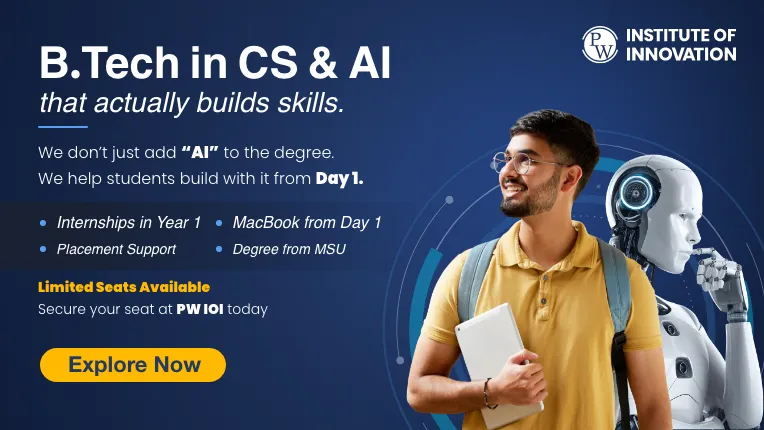
Start your future ever after with PWIOI's BTech Computer Science Program.
Are you ready to be the next tech innovator? PWIOI BTech in Computer Science is a program designed to give you the latest in hands-on science with AI, cloud computing, and cyber security skills, and more-all imparted by industry experts through real-life projects. Whether that dream involves getting a job with one of the largest tech giants in the world or starting your own company, this program opens the door to gaining the cutting-edge knowledge you need to succeed in the digital age.
Enroll now and turn your passion into a highly developed tech career!
Top 7 Generative AI Courses FAQ
What is a Generative AI course?
What career opportunities are available after completing a Generative AI course?
Why is learning Generative AI important in 2026?